
AB Soul VibeZ

The most esoteric rapper in a crew full of them. Nineteen tracks of Ab-Soul, who writes about conspiracy, grief, philosophy and his own eyesight, usually in the same verse.
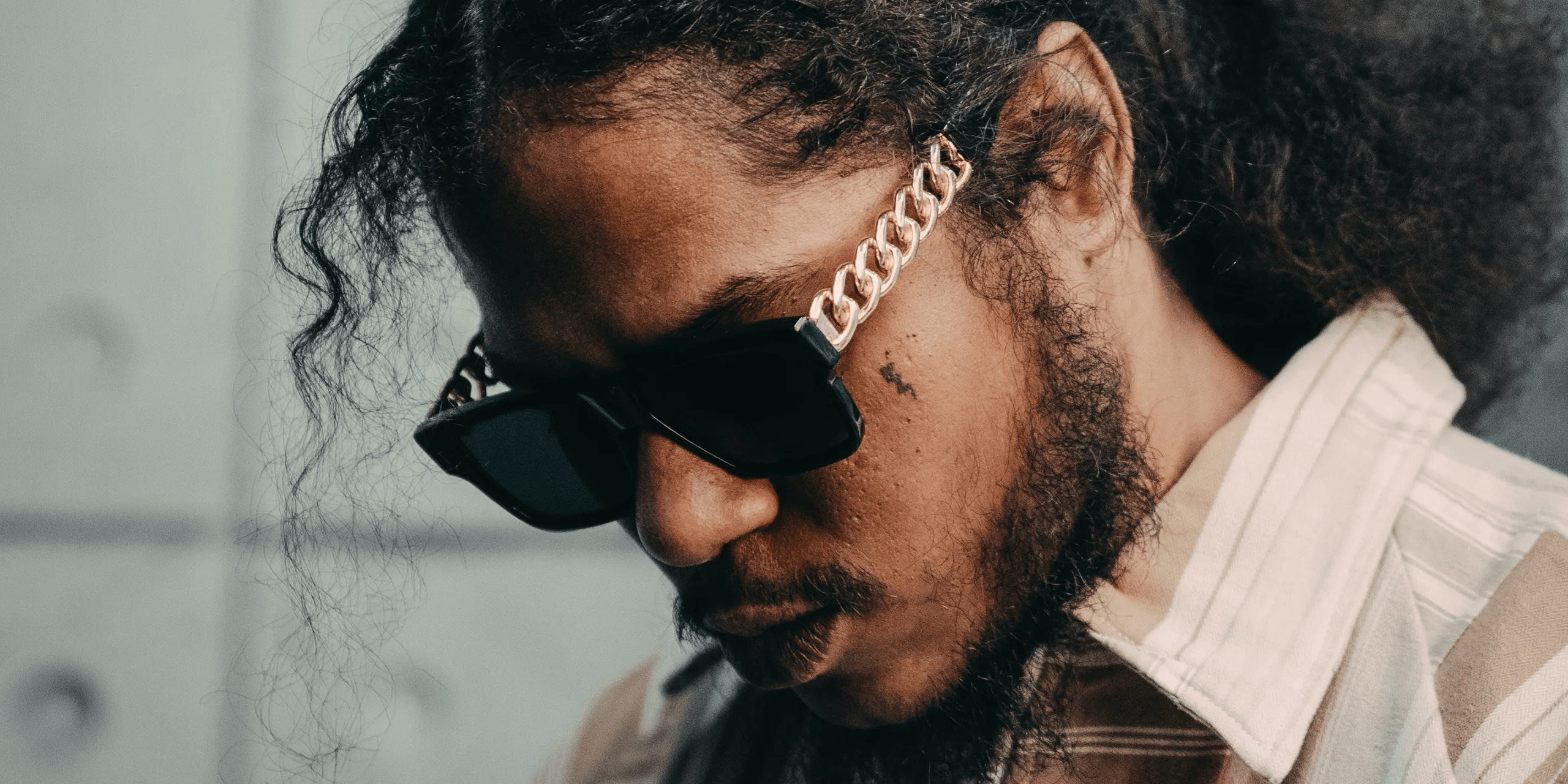

Black Hippy's strangest member

Herbert Anthony Stevens IV is from Carson, California, and is one of the four members of Black Hippy alongside Kendrick Lamar, ScHoolboy Q and Jay Rock — the Top Dawg Entertainment collective that became the most consequential rap crew of the 2010s.

Ab-Soul was always the one facing a different direction. He lives with Stevens–Johnson syndrome, a severe reaction he had as a child that damaged his eyes and skin and is the reason for the dark glasses. His writing runs toward the mystical and the conspiratorial — numerology, esoterica, religion, systems of control — delivered with a density of wordplay that rewards a lyrics sheet.

He has also written openly about the death by suicide of his partner, the artist Alori Joh, in 2012, and about his own suicide attempt. His 2022 album Herbert is largely about surviving both.

What to listen for

"Ab-Souls Outro" from Kendrick's Section.80 is where a lot of listeners first noticed him, and it is still one of the best verses in the TDE catalogue.

"The Recipe" in the Black Hippy remix is the full crew, and "Sail" in the TDE remix is the strangest artefact here.

"The Law" with Mac Miller and Rapsody is superb and, given Miller's death, difficult. "Bloody Waters" with Anderson .Paak and James Blake is the most sonically adventurous.

The Herbert material — "HERBERT," "DO BETTER," "FOMF," "NO REPORT CARD," "MESSAGE IN A BOTTLE" — is the most emotionally direct work he has done, and the album is his best.

"Tree of Life" is the deep-esoterica track for anyone who wants the full Ab-Soul experience.

Go deeper

Control System (2012) is the cult favourite and the one his audience holds closest; Herbert (2022) is the mature statement.

For the rest of the crew: Kendrick Lamar's good kid, m.A.A.d city, ScHoolboy Q's Oxymoron and Jay Rock's Redemption. TDE's development model — keep artists together, release slowly, let them appear on each other's records — is genuinely unusual and worth understanding.

For the lyrical lineage: Ras Kass, Canibus and KRS-One, three other rappers who built careers on density and esoterica.

One more thing worth saying. Ab-Soul has spent his career being described as the weird one in a crew that produced a Pulitzer winner, and the framing does him a disservice. The esoterica is not a gimmick; it is a genuine attempt to write about systems, mortality and meaning in a form that usually rewards neither. Herbert in particular is one of the most honest albums anyone has made about surviving a period that should have killed them, and it deserves to be heard as more than a footnote to somebody else's discography.

Comments

Popular posts from this blog

Monty Alexander VibeZ

There is a moment on almost every Monty Alexander record where the jazz piano trio stops behaving like a jazz piano trio and starts behaving like a Kingston sound system. That moment is the whole point. Fifty tracks deep, this is the sound of a man who never asked permission to be two things at once. The pianist who brought Kingston to the Carnegie stage Monty Alexander was born in Kingston, Jamaica in 1944, and by his teens he was already gigging around the island — close enough to the birth of ska and rocksteady to have absorbed it in his bones rather than learned it from records. He moved to the United States in 1961, and the origin story that follows is the kind that sounds invented: Frank Sinatra heard him playing in a Miami club, and Jilly Rizzo, Sinatra's friend and club owner, put him behind the piano at Jilly's in New York. From there Alexander fell in with Milt Jackson and Ray Brown, two of the most demanding rhythm partners in the music, and never really ...

GuiltyBeatZ VibeZ

If you have danced to anything out of Accra in the last ten years, you have probably danced to GuiltyBeatz without knowing his name. Forty-seven tracks of a producer's fingerprints — and the fingerprints turn out to be the melody. The Ghanaian producer who made Afrobeats swing Ronald Banful, who records as GuiltyBeatz, is a Ghanaian producer and DJ whose sound sits at the crossroads where Ghanaian highlife, Nigerian Afrobeats, amapiano and UK dance music all meet. He came up producing for Mr Eazi — the Banku Music partnership is where a lot of listeners first heard him — and his breakout as a name in his own right came with "Akwaaba," the 2018 track with Mr Eazi, Patapaa and Pappy Kojo that spawned a dance craze and became one of the defining African club records of its year. His reputation went global when he worked on Beyoncé's The Lion King: The Gift , but the more interesting story is the consistency. A GuiltyBeatz beat is usually ide...

Kashif VibeZ

Kashif is the reason a lot of 1980s R&B sounds the way it does — and the reason you can hear the difference between a synth bassline played by someone who understood bass and one programmed by someone who didn't. This is a producer's playlist, and the producer is everywhere. The architect of the synthesized soul record Kashif was born Michael Jones in Brooklyn in 1956, raised in foster care, and taught himself music young enough that by his teens he was touring with B.T. Express. What he did next reshaped a decade. In the early 1980s, as a producer, arranger and multi-instrumentalist, he was among the first to build R&B records around programmed synthesizers — the Minimoog bass, the Linn drum machine, the Fairlight — without letting them sound cold. That distinction matters. Plenty of producers adopted the new gear; Kashif made it groove . His basslines are played with the phrasing of a funk bassist, full of slides and ghost notes, which is why rec...