
Classic Recordings: “A Love Supreme” by John Coltrane

Four movements, thirty-three minutes, recorded in a single day in December 1964. This is not background music and it was never meant to be.
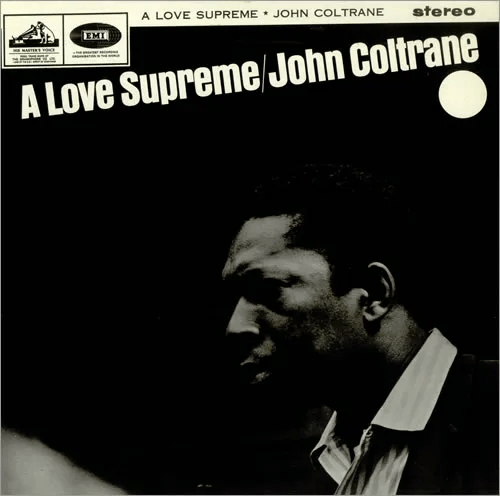

A Love Supreme

John Coltrane recorded A Love Supreme on 9 December 1964 at Rudy Van Gelder's studio in Englewood Cliffs, New Jersey, with the quartet that had been together for three years: McCoy Tyner on piano, Jimmy Garrison on bass and Elvin Jones on drums.

It is a devotional work. Coltrane had overcome heroin addiction in 1957 and described the experience as a spiritual awakening; this album is the offering he made in response. The liner notes, which he wrote himself, open with the words "Dear Listener: All Praise Be To God To Whom All Praise Is Due," and the fourth movement is a wordless setting of a poem he included in the sleeve — Coltrane plays the syllables of the text on the saxophone.

It sold in numbers almost no jazz record of its ambition has matched, and it has become a genuine sacred text; an African Orthodox church in San Francisco venerates Coltrane as a saint.

What to listen for

Part I – Acknowledgement is built on the four-note bass figure Garrison states at the opening. Coltrane plays it in every key across the movement — a deliberate demonstration that the phrase, and what it stands for, is everywhere — before he and the band chant the words "a love supreme" nineteen times.

Part II – Resolution is the most straightforwardly thrilling, driven by Elvin Jones, whose polyrhythmic drumming is one of the great individual contributions in the music.

Part III – Pursuance opens with an extended Jones solo and is the most technically demanding, with McCoy Tyner's quartal voicings underneath — a harmonic approach that changed how jazz pianists comp.

Part IV – Psalm is the prayer. Read the poem from the liner notes while it plays; the correspondence between the words and the phrasing is exact.

Go deeper

Giant Steps (1960) is the technical landmark, My Favorite Things (1961) the popular one, and Ascension (1966) the free-jazz leap.

Alice Coltrane's devotional recordings continue the project he began.

Ashley Kahn's book A Love Supreme: The Story of John Coltrane's Signature Album is excellent, and the complete recordings release includes a rarely-heard sextet version.

Coltrane died of liver cancer in July 1967. He was forty.

Listening note: resist the urge to shuffle this one. The four movements are an argument with a beginning and an end, and hearing them out of order is like reading a letter's paragraphs at random — every line is still beautiful, and none of it means what it should.

Comments

Popular posts from this blog

Monty Alexander VibeZ

There is a moment on almost every Monty Alexander record where the jazz piano trio stops behaving like a jazz piano trio and starts behaving like a Kingston sound system. That moment is the whole point. Fifty tracks deep, this is the sound of a man who never asked permission to be two things at once. The pianist who brought Kingston to the Carnegie stage Monty Alexander was born in Kingston, Jamaica in 1944, and by his teens he was already gigging around the island — close enough to the birth of ska and rocksteady to have absorbed it in his bones rather than learned it from records. He moved to the United States in 1961, and the origin story that follows is the kind that sounds invented: Frank Sinatra heard him playing in a Miami club, and Jilly Rizzo, Sinatra's friend and club owner, put him behind the piano at Jilly's in New York. From there Alexander fell in with Milt Jackson and Ray Brown, two of the most demanding rhythm partners in the music, and never really ...

GuiltyBeatZ VibeZ

If you have danced to anything out of Accra in the last ten years, you have probably danced to GuiltyBeatz without knowing his name. Forty-seven tracks of a producer's fingerprints — and the fingerprints turn out to be the melody. The Ghanaian producer who made Afrobeats swing Ronald Banful, who records as GuiltyBeatz, is a Ghanaian producer and DJ whose sound sits at the crossroads where Ghanaian highlife, Nigerian Afrobeats, amapiano and UK dance music all meet. He came up producing for Mr Eazi — the Banku Music partnership is where a lot of listeners first heard him — and his breakout as a name in his own right came with "Akwaaba," the 2018 track with Mr Eazi, Patapaa and Pappy Kojo that spawned a dance craze and became one of the defining African club records of its year. His reputation went global when he worked on Beyoncé's The Lion King: The Gift , but the more interesting story is the consistency. A GuiltyBeatz beat is usually ide...

Kashif VibeZ

Kashif is the reason a lot of 1980s R&B sounds the way it does — and the reason you can hear the difference between a synth bassline played by someone who understood bass and one programmed by someone who didn't. This is a producer's playlist, and the producer is everywhere. The architect of the synthesized soul record Kashif was born Michael Jones in Brooklyn in 1956, raised in foster care, and taught himself music young enough that by his teens he was touring with B.T. Express. What he did next reshaped a decade. In the early 1980s, as a producer, arranger and multi-instrumentalist, he was among the first to build R&B records around programmed synthesizers — the Minimoog bass, the Linn drum machine, the Fairlight — without letting them sound cold. That distinction matters. Plenty of producers adopted the new gear; Kashif made it groove . His basslines are played with the phrasing of a funk bassist, full of slides and ghost notes, which is why rec...