
Wu-Tang Forever

Fifty-four tracks tracing what happened after nine men from Staten Island signed a deal that let each of them sign somewhere else.
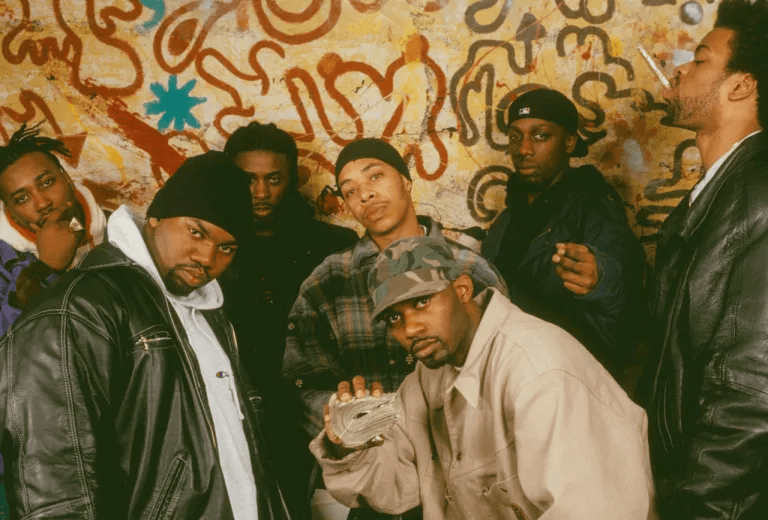

The solo-deal clause

Wu-Tang Clan arrived in 1993 with Enter the Wu-Tang (36 Chambers) and a business arrangement that had no precedent: RZA negotiated a group deal that explicitly allowed every member to sign individually to any label they chose. It was, in retrospect, one of the smartest moves anyone in the genre has made.

What followed was an extraordinary run of solo albums — Method Man's Tical, Raekwon's Only Built 4 Cuban Linx, GZA's Liquid Swords, Ghostface Killah's Ironman, Ol' Dirty Bastard's Return to the 36 Chambers — mostly produced by RZA, and collectively more influential than the group albums.

This playlist concentrates on that solo material and on the R&B crossover records, which is the right emphasis — it is where the Clan's reach is widest.

What to listen for

"I'll Be There For You / You're All I Need" with Mary J. Blige is the record that made Method Man a star outside the group and won a Grammy. It remains the template for the rap-and-soul duet.

"Da Rockwilder" with Redman is two minutes and sixteen seconds of pure momentum and is close to perfect.

Ghostface Killah's "All That I Got Is You" is the emotional centre of the whole list — a song about childhood poverty, with Mary J. Blige on the hook, and one of the most affecting records in the genre.

"Cherchez LaGhost" flips a Dr. Buzzard's Original Savannah Band record and is the strangest hit Ghostface had.

"Back Like That" in the remix with Ne-Yo and Kanye West shows how far the Clan's reach extended by the mid-2000s.

"Break Ups 2 Make Ups" pairs Method Man with D'Angelo, and "Wings Of The Morning" with Capleton is the dancehall connection.

"Cisco Kid" assembles Method Man, Redman, Cypress Hill and War, which is a genuinely strange lineup.

Go deeper

Enter the Wu-Tang (36 Chambers) (1993) is the foundational album, and Raekwon's Only Built 4 Cuban Linx is the solo masterpiece.

Ghostface Killah's Supreme Clientele is the one rap critics argue about most, and the argument is generally that it is the best.

RZA's production is the through-line: dusty soul samples, unquantised drums, and kung-fu film dialogue. The Shaolin films he sampled are worth watching for context.

Ol' Dirty Bastard died in 2004 and Nine members is now eight.

Comments

Popular posts from this blog

Monty Alexander VibeZ

There is a moment on almost every Monty Alexander record where the jazz piano trio stops behaving like a jazz piano trio and starts behaving like a Kingston sound system. That moment is the whole point. Fifty tracks deep, this is the sound of a man who never asked permission to be two things at once. The pianist who brought Kingston to the Carnegie stage Monty Alexander was born in Kingston, Jamaica in 1944, and by his teens he was already gigging around the island — close enough to the birth of ska and rocksteady to have absorbed it in his bones rather than learned it from records. He moved to the United States in 1961, and the origin story that follows is the kind that sounds invented: Frank Sinatra heard him playing in a Miami club, and Jilly Rizzo, Sinatra's friend and club owner, put him behind the piano at Jilly's in New York. From there Alexander fell in with Milt Jackson and Ray Brown, two of the most demanding rhythm partners in the music, and never really ...

GuiltyBeatZ VibeZ

If you have danced to anything out of Accra in the last ten years, you have probably danced to GuiltyBeatz without knowing his name. Forty-seven tracks of a producer's fingerprints — and the fingerprints turn out to be the melody. The Ghanaian producer who made Afrobeats swing Ronald Banful, who records as GuiltyBeatz, is a Ghanaian producer and DJ whose sound sits at the crossroads where Ghanaian highlife, Nigerian Afrobeats, amapiano and UK dance music all meet. He came up producing for Mr Eazi — the Banku Music partnership is where a lot of listeners first heard him — and his breakout as a name in his own right came with "Akwaaba," the 2018 track with Mr Eazi, Patapaa and Pappy Kojo that spawned a dance craze and became one of the defining African club records of its year. His reputation went global when he worked on Beyoncé's The Lion King: The Gift , but the more interesting story is the consistency. A GuiltyBeatz beat is usually ide...

Kashif VibeZ

Kashif is the reason a lot of 1980s R&B sounds the way it does — and the reason you can hear the difference between a synth bassline played by someone who understood bass and one programmed by someone who didn't. This is a producer's playlist, and the producer is everywhere. The architect of the synthesized soul record Kashif was born Michael Jones in Brooklyn in 1956, raised in foster care, and taught himself music young enough that by his teens he was touring with B.T. Express. What he did next reshaped a decade. In the early 1980s, as a producer, arranger and multi-instrumentalist, he was among the first to build R&B records around programmed synthesizers — the Minimoog bass, the Linn drum machine, the Fairlight — without letting them sound cold. That distinction matters. Plenty of producers adopted the new gear; Kashif made it groove . His basslines are played with the phrasing of a funk bassist, full of slides and ghost notes, which is why rec...