
Elmiene VibeZ

Elmiene sings like the last fifty years of soul music happened yesterday and he was in the room for all of it. Twenty-three tracks from one of the most striking voices to come out of Britain in years.
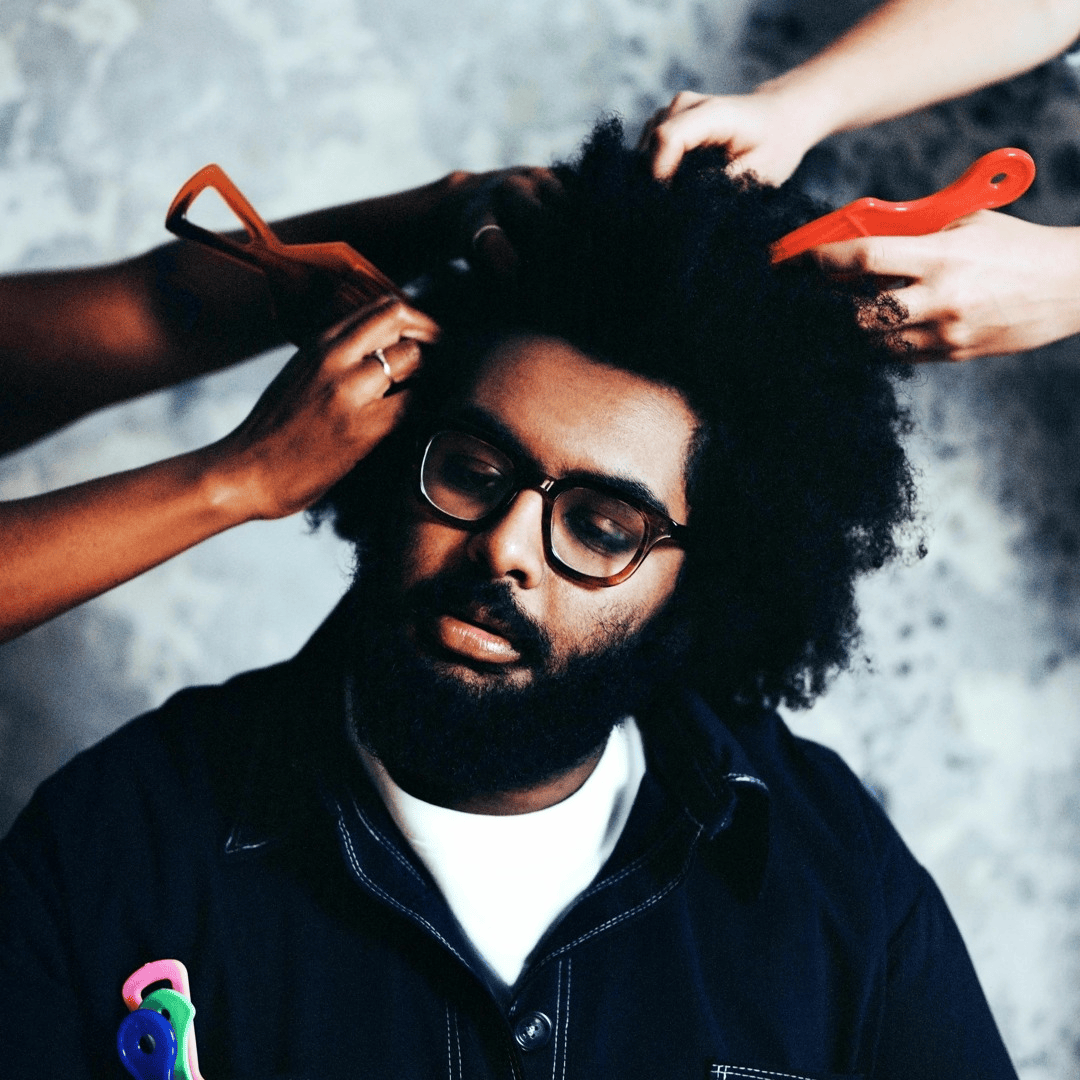

Oxford, Sudan, and a voice out of time

Elmiene — born Abdel Mahmoud, of Sudanese heritage and raised in Oxford — arrived almost fully formed. A cover posted online caught fire, and within a short stretch he had signed with Polydor, been championed by Virgil Abloh's Louis Vuitton, and been claimed by a lot of people as the natural inheritor of a lineage running through Donny Hathaway, D'Angelo and Frank Ocean.

The comparisons are lazy but not wrong about the essential thing: his voice has a grain and a weight that sounds like it belongs to an older recording. He phrases behind the beat, uses falsetto sparingly, and has an instinct for when to leave a line unfinished. In an era of technically flawless singing, he sounds like a person.

What to listen for

The Live From 525 sessions are the heart of this playlist and the best introduction. "Pink Matter" — the Frank Ocean song — and Prince's "Sometimes It Snows In April" are both enormous risks for a young singer, and he handles them by refusing to perform them as tributes. "Sideways" and "Slow Jam" from the same sessions are looser and just as good.

Of the originals, "Golden" and "Mama" are the emotional centre — the latter is the one that tends to stop people. "Someday" (which appears twice here, in different versions) and "Crystal Tears" show the writing developing.

"Marking My Time" in the BADBADNOTGOOD edit is the most interesting production on the list — the Toronto band's jazz instincts give him a much rougher, more live setting than his studio records usually allow.

"Sweetness" with Leon Thomas pairs him with another singer having a moment, and "Why (Spare Me Tears)" and "TLC" close out the more recent material.

Twenty-three tracks. Headphones, please.

Go deeper

His EPs — Marking My Time and For the Loving and the Lost — are short and worth hearing complete. The Live From 525 session is the single best introduction and should be watched as well as heard.

For the lineage the comparisons point at: Donny Hathaway Live is the record that everything in this tradition measures itself against. D'Angelo's Voodoo and Frank Ocean's Blonde are the modern poles.

Among his British contemporaries, Sam Wills, Bellah and Shae Universe are part of the same wave. And for the Sudanese thread, Sinkane and Alsarah & the Nubatones are worth finding — different music entirely, same diaspora.

Comments

Popular posts from this blog

Monty Alexander VibeZ

There is a moment on almost every Monty Alexander record where the jazz piano trio stops behaving like a jazz piano trio and starts behaving like a Kingston sound system. That moment is the whole point. Fifty tracks deep, this is the sound of a man who never asked permission to be two things at once. The pianist who brought Kingston to the Carnegie stage Monty Alexander was born in Kingston, Jamaica in 1944, and by his teens he was already gigging around the island — close enough to the birth of ska and rocksteady to have absorbed it in his bones rather than learned it from records. He moved to the United States in 1961, and the origin story that follows is the kind that sounds invented: Frank Sinatra heard him playing in a Miami club, and Jilly Rizzo, Sinatra's friend and club owner, put him behind the piano at Jilly's in New York. From there Alexander fell in with Milt Jackson and Ray Brown, two of the most demanding rhythm partners in the music, and never really ...

GuiltyBeatZ VibeZ

If you have danced to anything out of Accra in the last ten years, you have probably danced to GuiltyBeatz without knowing his name. Forty-seven tracks of a producer's fingerprints — and the fingerprints turn out to be the melody. The Ghanaian producer who made Afrobeats swing Ronald Banful, who records as GuiltyBeatz, is a Ghanaian producer and DJ whose sound sits at the crossroads where Ghanaian highlife, Nigerian Afrobeats, amapiano and UK dance music all meet. He came up producing for Mr Eazi — the Banku Music partnership is where a lot of listeners first heard him — and his breakout as a name in his own right came with "Akwaaba," the 2018 track with Mr Eazi, Patapaa and Pappy Kojo that spawned a dance craze and became one of the defining African club records of its year. His reputation went global when he worked on Beyoncé's The Lion King: The Gift , but the more interesting story is the consistency. A GuiltyBeatz beat is usually ide...

Kashif VibeZ

Kashif is the reason a lot of 1980s R&B sounds the way it does — and the reason you can hear the difference between a synth bassline played by someone who understood bass and one programmed by someone who didn't. This is a producer's playlist, and the producer is everywhere. The architect of the synthesized soul record Kashif was born Michael Jones in Brooklyn in 1956, raised in foster care, and taught himself music young enough that by his teens he was touring with B.T. Express. What he did next reshaped a decade. In the early 1980s, as a producer, arranger and multi-instrumentalist, he was among the first to build R&B records around programmed synthesizers — the Minimoog bass, the Linn drum machine, the Fairlight — without letting them sound cold. That distinction matters. Plenty of producers adopted the new gear; Kashif made it groove . His basslines are played with the phrasing of a funk bassist, full of slides and ghost notes, which is why rec...