The last album released in Bob Marley's lifetime, and the one that ends with a man alone with an acoustic guitar telling you to free your own mind. Ten tracks, and the weight of everything after.
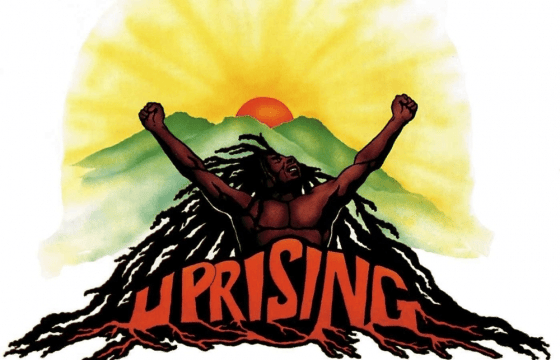
Uprising, 1980
Uprising arrived in June 1980. Marley had been diagnosed with melanoma in 1977 and had declined the amputation that might have stopped it. He toured Europe behind this record, collapsed while jogging in Central Park in September, and died the following May at thirty-six.
Whether he knew how little time he had is a question the album makes almost unbearable. It is his most explicitly spiritual record — heavier on Rastafari devotion than on the romantic material that had widened his audience — and it closes with a song that reads, unavoidably, as a summing-up.
What to listen for
"Redemption Song" is the reason this album occupies the place it does. Just Marley and an acoustic guitar — no band, no Wailers, no I Threes — drawing its central lines from a 1937 speech by Marcus Garvey. It is the most naked thing he ever recorded and one of the most important songs of the twentieth century. The band version included here as a bonus is fascinating precisely because it demonstrates how much the solo arrangement was the right call.
"Could You Be Loved" is the other pole — disco-adjacent, built for radio, and the record that kept the album commercially alive. That both songs sit on the same LP is the whole Marley proposition in miniature.
"Coming In From The Cold" opens with a lyric about the shortness of life that is difficult to hear now. "Real Situation" and "We And Dem" are among his bleakest.
"Zion Train" and "Forever Loving Jah" carry the devotional weight, and "Pimper's Paradise" is the sharpest social observation on the record.
"Bad Card" is a rare moment of humour — a swipe at someone who underestimated him.
Go deeper
Survival (1979) is the album immediately before, and the most explicitly pan-Africanist thing he made — it is also the least played and arguably the most urgent. Confrontation (1983) was assembled posthumously from the same sessions.
Marcus Garvey is worth reading directly if "Redemption Song" means anything to you; the 1937 Nova Scotia speech is where the mental-slavery line comes from.
And for the band: the Barrett brothers, Carlton and Aston, are the rhythm section that made all of this possible, and Carlton's one-drop drumming is one of the great individual contributions in popular music.
Comments
Post a Comment