
The Soulful Baritones of R&B Vol. 1

Fifty-nine tracks selected on one criterion: the voice has to sit low and mean it. This is a playlist about the bottom of the male range.
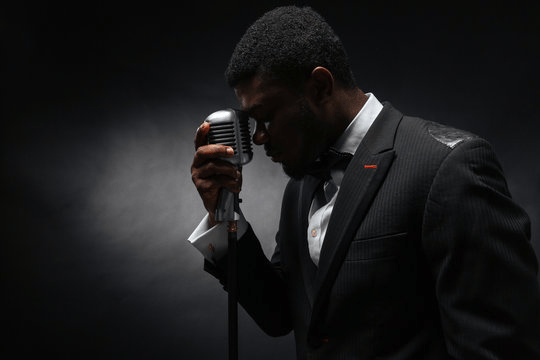

The register that built quiet storm radio

There is a specific thing a deep male voice does in soul music, and it has almost nothing to do with power. A baritone sitting close to the microphone at a slow tempo creates an intimacy that a tenor cannot — it is the reason the entire quiet storm format exists, and the reason so much of this repertoire is built for late-night listening.

What is impressive about this selection is its historical range. It runs from Ben E. King in 1961 to Leon Bridges and Leslie Odom Jr., and the through-line holds across sixty years because the physical quality being selected for does not change.

What to listen for

Donny Hathaway's "For All We Know" is the standard against which the rest of the playlist measures itself. Nobody has ever done more with less.

Barry White's "I've Got So Much To Give" is the most extreme example of the register — White's voice sits so low it is almost speech, and his arrangements built an entire aesthetic around it.

The Dells appear twice, and Marvin Junior's lead vocal is one of the most underappreciated instruments in soul history. "The Love We Had (Stays On My Mind)" is the essential.

Will Downing's "I Can't Make You Love Me" and Peabo Bryson's two entries represent the smooth end at its most accomplished.

Larry Graham's "When We Get Married" is worth noting — Graham invented slap bass in Sly and the Family Stone and then had a second career as a balladeer, which is a remarkably wide range of contributions.

L.T.D.'s "Love Ballad" features a young Jeffrey Osborne, and D-Train's "You're the Reason" brings the boogie era in.

Leon Bridges' "Lisa Sawyer" — about his mother — and Leslie Odom Jr. and Leon Timbo show the tradition is still being fed.

Go deeper

The Dells deserve proper investigation — a group that recorded across five decades with essentially the same lineup, which almost nobody managed.

Donny Hathaway Live, again, is the record everything in this territory answers to.

And for the outer limits of the register: Isaac Hayes, Teddy Pendergrass, Lou Rawls and Johnny Hartman — the last of whom made one album with John Coltrane that is among the most beautiful vocal records ever made.

Comments

Popular posts from this blog

Monty Alexander VibeZ

There is a moment on almost every Monty Alexander record where the jazz piano trio stops behaving like a jazz piano trio and starts behaving like a Kingston sound system. That moment is the whole point. Fifty tracks deep, this is the sound of a man who never asked permission to be two things at once. The pianist who brought Kingston to the Carnegie stage Monty Alexander was born in Kingston, Jamaica in 1944, and by his teens he was already gigging around the island — close enough to the birth of ska and rocksteady to have absorbed it in his bones rather than learned it from records. He moved to the United States in 1961, and the origin story that follows is the kind that sounds invented: Frank Sinatra heard him playing in a Miami club, and Jilly Rizzo, Sinatra's friend and club owner, put him behind the piano at Jilly's in New York. From there Alexander fell in with Milt Jackson and Ray Brown, two of the most demanding rhythm partners in the music, and never really ...

GuiltyBeatZ VibeZ

If you have danced to anything out of Accra in the last ten years, you have probably danced to GuiltyBeatz without knowing his name. Forty-seven tracks of a producer's fingerprints — and the fingerprints turn out to be the melody. The Ghanaian producer who made Afrobeats swing Ronald Banful, who records as GuiltyBeatz, is a Ghanaian producer and DJ whose sound sits at the crossroads where Ghanaian highlife, Nigerian Afrobeats, amapiano and UK dance music all meet. He came up producing for Mr Eazi — the Banku Music partnership is where a lot of listeners first heard him — and his breakout as a name in his own right came with "Akwaaba," the 2018 track with Mr Eazi, Patapaa and Pappy Kojo that spawned a dance craze and became one of the defining African club records of its year. His reputation went global when he worked on Beyoncé's The Lion King: The Gift , but the more interesting story is the consistency. A GuiltyBeatz beat is usually ide...

Kashif VibeZ

Kashif is the reason a lot of 1980s R&B sounds the way it does — and the reason you can hear the difference between a synth bassline played by someone who understood bass and one programmed by someone who didn't. This is a producer's playlist, and the producer is everywhere. The architect of the synthesized soul record Kashif was born Michael Jones in Brooklyn in 1956, raised in foster care, and taught himself music young enough that by his teens he was touring with B.T. Express. What he did next reshaped a decade. In the early 1980s, as a producer, arranger and multi-instrumentalist, he was among the first to build R&B records around programmed synthesizers — the Minimoog bass, the Linn drum machine, the Fairlight — without letting them sound cold. That distinction matters. Plenty of producers adopted the new gear; Kashif made it groove . His basslines are played with the phrasing of a funk bassist, full of slides and ghost notes, which is why rec...