Thirty-one tracks from the woman who fused hip-hop and soul so completely that nobody has been able to separate them since. Mary J. Blige earned the title.
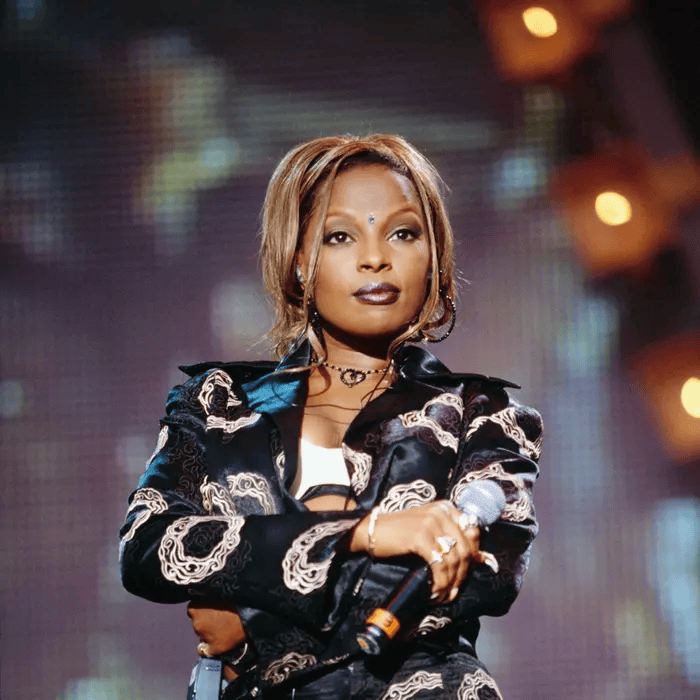
The Queen of Hip-Hop Soul
Mary J. Blige was discovered singing an Anita Baker cover into a karaoke machine at a mall in Yonkers. The tape reached Uptown Records, where Sean Combs was an A&R executive, and the combination they arrived at — a gospel-rooted soul voice over hard hip-hop production, sung by someone dressed like the neighbourhood rather than like a diva — changed R&B permanently.
What's the 411? (1992) established the template. My Life (1994) — made during a period of depression and addiction she has since discussed at length — is the record her audience holds closest, and one of the most emotionally raw albums in the genre.
She has since won nine Grammys, been nominated for two Academy Awards in the same year for Mudbound, and entered the Rock and Roll Hall of Fame. The through-line across thirty years is that she never learned to perform composure.
What to listen for
"Real Love" and "You Remind Me" are the early records that made her, both built on hard breakbeats.
"My Life" and "Take Me As I Am" are the emotional core, and "Not Gon' Cry" — from Waiting to Exhale, written by Babyface — is one of the great vocal performances of the 1990s.
"Be Without You" in the Kendu Mix is the most successful record of her career, spending an extraordinary run atop the R&B chart.
The duets are the genre in miniature. "I'll Be There For You / You're All I Need" with Method Man won a Grammy and remains the definitive rap-and-soul pairing. "All That I Can Say" was written and produced by Lauryn Hill, and "Love @ 1st Sight" returns to Method Man.
"Everything" is built on the Stylistics, "Sweet Thing" is the Chaka Khan cover, and Sam Smith's "Stay With Me" is the late-career crossover.
"MJB Da MVP" is the one where she states the case herself.
Go deeper
My Life (1994) is the album. There is a documentary of the same name that is worth watching alongside it.
The Breakthrough (2005) is the commercial peak, and No More Drama (2001) the turning point.
For what she made possible: essentially every R&B singer who has worked with a rapper since 1992, which is all of them. The specific debt is clearest in Keyshia Cole, Jazmine Sullivan and Summer Walker.
Comments
Post a Comment