
Loose Ends VibeZ

Ten tracks from the British band who made one of the most sampled records in soul history and never quite got the credit at home.
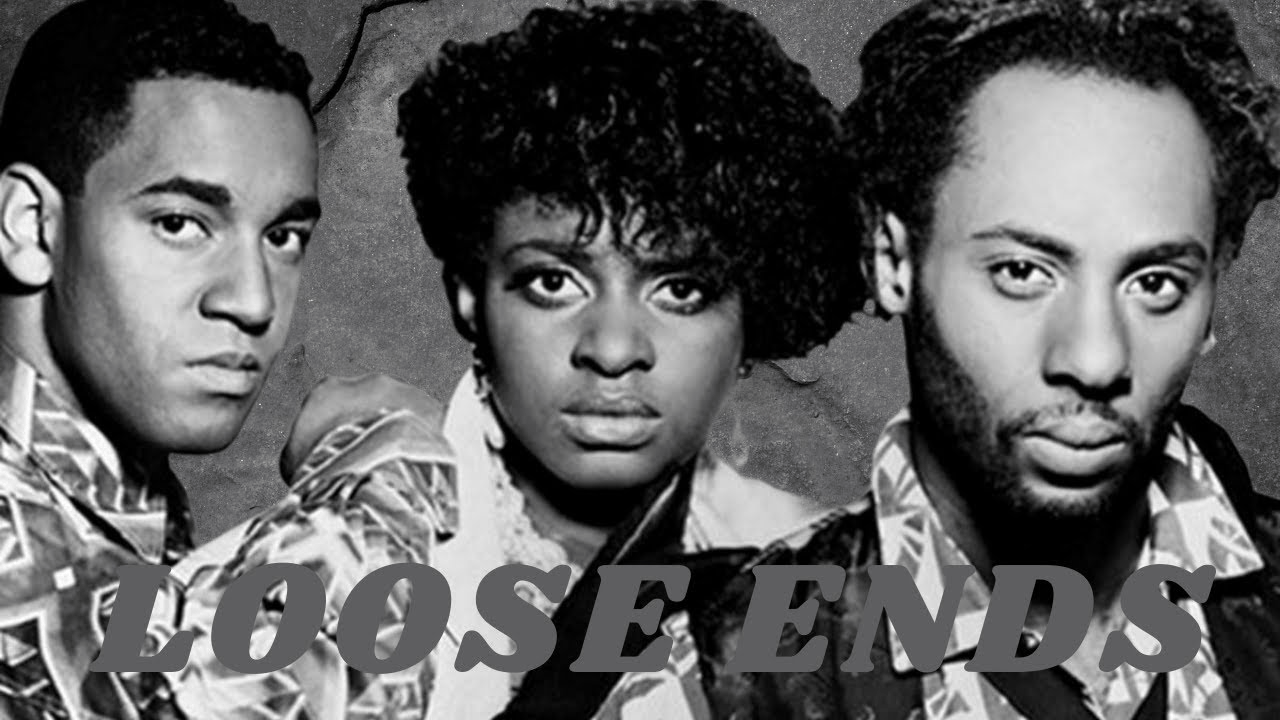

Loose Ends

Loose Ends — Carl McIntosh, Jane Eugene and Steve Nichol — formed in south London and became, in 1985, the first British Black group to reach number one on the US R&B chart. That is a genuinely significant milestone and it is remarkably little discussed.

Their sound was a specific British thing: the sleek machine funk of the mid-1980s crossed with a jazz-funk sensibility that came out of the UK's rare groove and soul weekender culture. Working with producer Nick Martinelli in Philadelphia, they arrived at a hybrid that was polished enough for American radio and strange enough to stand apart from it.

What to listen for

"Hangin' On A String (Contemplating)" is the record. That number one R&B hit is built on a groove that has been sampled and interpolated endlessly, and the production — that dry drum machine, the clipped guitar, the enormous space — still sounds contemporary forty years on.

"Slow Down" is the other one DJs reach for, and "Stay A Little While, Child" is the most beautiful thing they made.

"Don't Be A Fool" and "Nights Of Pleasure" are the deeper cuts that the British soul scene holds closest.

"You Can't Stop The Rain" and "Symptoms Of Love" show Jane Eugene's lead vocals at their best — a cool, slightly detached delivery that suits the production perfectly.

"Hold Tight" and "Don't You Ever (Try To Change Me)" round it out.

Listen throughout to how little is happening. These records are built on subtraction, and the space is what gives them their weight.

Go deeper

So Where Are You? (1985) and Zagora (1986) are the albums.

Nick Martinelli is the producer to follow — a Philadelphian who worked extensively with British soul acts and shaped a great deal of the transatlantic sound of that decade.

For the wider British scene: Incognito, The Brand New Heavies, Soul II Soul, Omar and Central Line. And for the sampling trail, "Hangin' On A String" will take you through a startling amount of 1990s hip-hop and house.

A closing note on the British angle. Loose Ends reaching number one on the American R&B chart in 1985 should be a much bigger part of how British music history gets told, and it is barely mentioned. The UK soul scene of that decade — the weekenders, the pirate stations, the specialist DJs — produced music that competed on equal terms with anything from New York or Philadelphia, and almost none of it has been properly documented.

Comments

Popular posts from this blog

Monty Alexander VibeZ

There is a moment on almost every Monty Alexander record where the jazz piano trio stops behaving like a jazz piano trio and starts behaving like a Kingston sound system. That moment is the whole point. Fifty tracks deep, this is the sound of a man who never asked permission to be two things at once. The pianist who brought Kingston to the Carnegie stage Monty Alexander was born in Kingston, Jamaica in 1944, and by his teens he was already gigging around the island — close enough to the birth of ska and rocksteady to have absorbed it in his bones rather than learned it from records. He moved to the United States in 1961, and the origin story that follows is the kind that sounds invented: Frank Sinatra heard him playing in a Miami club, and Jilly Rizzo, Sinatra's friend and club owner, put him behind the piano at Jilly's in New York. From there Alexander fell in with Milt Jackson and Ray Brown, two of the most demanding rhythm partners in the music, and never really ...

GuiltyBeatZ VibeZ

If you have danced to anything out of Accra in the last ten years, you have probably danced to GuiltyBeatz without knowing his name. Forty-seven tracks of a producer's fingerprints — and the fingerprints turn out to be the melody. The Ghanaian producer who made Afrobeats swing Ronald Banful, who records as GuiltyBeatz, is a Ghanaian producer and DJ whose sound sits at the crossroads where Ghanaian highlife, Nigerian Afrobeats, amapiano and UK dance music all meet. He came up producing for Mr Eazi — the Banku Music partnership is where a lot of listeners first heard him — and his breakout as a name in his own right came with "Akwaaba," the 2018 track with Mr Eazi, Patapaa and Pappy Kojo that spawned a dance craze and became one of the defining African club records of its year. His reputation went global when he worked on Beyoncé's The Lion King: The Gift , but the more interesting story is the consistency. A GuiltyBeatz beat is usually ide...

Kashif VibeZ

Kashif is the reason a lot of 1980s R&B sounds the way it does — and the reason you can hear the difference between a synth bassline played by someone who understood bass and one programmed by someone who didn't. This is a producer's playlist, and the producer is everywhere. The architect of the synthesized soul record Kashif was born Michael Jones in Brooklyn in 1956, raised in foster care, and taught himself music young enough that by his teens he was touring with B.T. Express. What he did next reshaped a decade. In the early 1980s, as a producer, arranger and multi-instrumentalist, he was among the first to build R&B records around programmed synthesizers — the Minimoog bass, the Linn drum machine, the Fairlight — without letting them sound cold. That distinction matters. Plenty of producers adopted the new gear; Kashif made it groove . His basslines are played with the phrasing of a funk bassist, full of slides and ghost notes, which is why rec...