
Busta Rhymes BangerZ

Thirty tracks from the most physically astonishing rapper alive. Busta Rhymes has been doing things with breath control that nobody else attempts for thirty-five years.
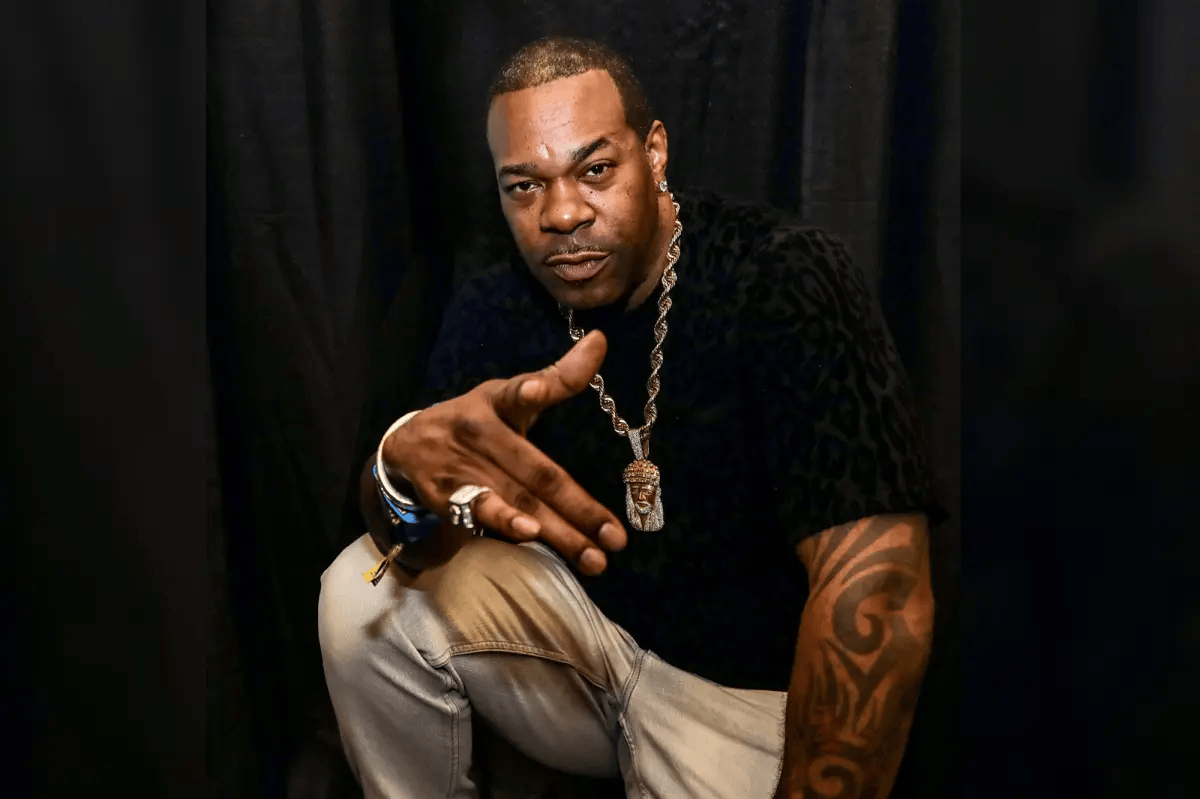

Trevor Smith Jr.

Busta Rhymes was born in Brooklyn to Jamaican parents, and that Caribbean inheritance is the key to everything — his rapid-fire, patois-inflected delivery comes directly out of the Jamaican deejay tradition, sped up and applied to New York rap.

He came up in Leaders of the New School, and his verse on A Tribe Called Quest's "Scenario" in 1991 is one of the most famous guest appearances in the genre's history — the moment a supporting player took over a record entirely.

What followed was a solo career built on two things: a physical technique that few rappers can approach, and an understanding that hip-hop was a visual medium. His videos with Hype Williams are among the most inventive ever made.

What to listen for

"Woo Hah!! Got You All in Check" and "Put Your Hands Where My Eyes Could See" are the two that made him a star, and both are pure kinetic energy.

"Gimme Some More" is the technical peak — built on a sample from Bernard Herrmann's Psycho score, and one of the most unsettling hit records ever made.

"Touch It" and "Dangerous" are the biggest, and "What's It Gonna Be?!" with Janet Jackson came with a video that reportedly cost over two million dollars.

"I Know What You Want" with Mariah Carey is the crossover, and "Victory" with Biggie and Diddy is the posse cut.

The collaborations show his range: Luther Vandross's "Lovely Day," Sean Paul's "Gimme the Light," The Pussycat Dolls' "Don't Cha" and Rick James on "In The Ghetto."

"Rastaman Chant" with the Wailers is the Jamaican thread made explicit — from the Chant Down Babylon project, and the clearest evidence of where the delivery comes from.

Go deeper

The Coming (1996) and When Disaster Strikes... (1997) are the two albums, and Extinction Level Event 2 (2020) is the late-career return that surprised everyone by being good.

A Tribe Called Quest's The Low End Theory for "Scenario," and the Hype Williams videos are essential viewing rather than optional.

For the Jamaican deejay tradition underneath it all: Super Cat, Ranking Joe and U-Roy. Once you hear the connection you cannot unhear it.

A closing note on the physical technique. Breath control at the speed Busta Rhymes works is genuinely athletic, and it is worth listening to a track like "Gimme Some More" purely for where he takes a breath — which is almost nowhere. Thirty-five years in, he can still do it live, which is the part that most rappers half his age cannot match.

Comments

Popular posts from this blog

Monty Alexander VibeZ

There is a moment on almost every Monty Alexander record where the jazz piano trio stops behaving like a jazz piano trio and starts behaving like a Kingston sound system. That moment is the whole point. Fifty tracks deep, this is the sound of a man who never asked permission to be two things at once. The pianist who brought Kingston to the Carnegie stage Monty Alexander was born in Kingston, Jamaica in 1944, and by his teens he was already gigging around the island — close enough to the birth of ska and rocksteady to have absorbed it in his bones rather than learned it from records. He moved to the United States in 1961, and the origin story that follows is the kind that sounds invented: Frank Sinatra heard him playing in a Miami club, and Jilly Rizzo, Sinatra's friend and club owner, put him behind the piano at Jilly's in New York. From there Alexander fell in with Milt Jackson and Ray Brown, two of the most demanding rhythm partners in the music, and never really ...

GuiltyBeatZ VibeZ

If you have danced to anything out of Accra in the last ten years, you have probably danced to GuiltyBeatz without knowing his name. Forty-seven tracks of a producer's fingerprints — and the fingerprints turn out to be the melody. The Ghanaian producer who made Afrobeats swing Ronald Banful, who records as GuiltyBeatz, is a Ghanaian producer and DJ whose sound sits at the crossroads where Ghanaian highlife, Nigerian Afrobeats, amapiano and UK dance music all meet. He came up producing for Mr Eazi — the Banku Music partnership is where a lot of listeners first heard him — and his breakout as a name in his own right came with "Akwaaba," the 2018 track with Mr Eazi, Patapaa and Pappy Kojo that spawned a dance craze and became one of the defining African club records of its year. His reputation went global when he worked on Beyoncé's The Lion King: The Gift , but the more interesting story is the consistency. A GuiltyBeatz beat is usually ide...

Kashif VibeZ

Kashif is the reason a lot of 1980s R&B sounds the way it does — and the reason you can hear the difference between a synth bassline played by someone who understood bass and one programmed by someone who didn't. This is a producer's playlist, and the producer is everywhere. The architect of the synthesized soul record Kashif was born Michael Jones in Brooklyn in 1956, raised in foster care, and taught himself music young enough that by his teens he was touring with B.T. Express. What he did next reshaped a decade. In the early 1980s, as a producer, arranger and multi-instrumentalist, he was among the first to build R&B records around programmed synthesizers — the Minimoog bass, the Linn drum machine, the Fairlight — without letting them sound cold. That distinction matters. Plenty of producers adopted the new gear; Kashif made it groove . His basslines are played with the phrasing of a funk bassist, full of slides and ghost notes, which is why rec...