
The Hamiltones VibeZ

Eighteen tracks from three men who started as Anthony Hamilton's backing singers and turned out to have one of the most powerful things in music: a real blend.
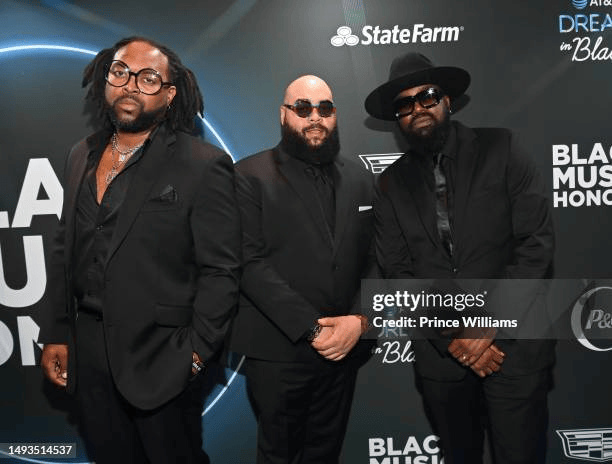

The HamilTones

The HamilTones2E (Anthony Eastin), J. Vito and Tony Lelo — began as the backing vocal trio for Anthony Hamilton, which is where the name comes from. They became known in their own right through viral videos: three men in a car or a hotel room, harmonising, frequently taking material nobody would expect and turning it into church.

What they have is genuinely rare. All three are gospel-trained, all three can lead, and the blend between them is tight enough that they can perform with no instruments at all and hold a room.

Their later work has become substantially more political, and that turn is the most interesting thing about them.

What to listen for

The a cappella arrangements are the whole event. "Never Gonna Let You Go" and "Best Friend" show what three voices can do with no support at all.

"What I'm Feelin'" with Anthony Hamilton is the origin point, and "Doo Wop Thank Me" with Snoop Dogg is the most unexpected pairing.

"MCBYL" with Phonte of Little Brother and Rico Barrino connects them to the North Carolina soul world they come from.

The political material is the reason to take them seriously as more than a harmony act. "Nat Turner Intro" and "Nat Turner (Yours Alone)" address the leader of the 1831 Virginia slave rebellion. "James Baldwin," "Nina Simone" and "Congressman John Lewis" are portraits. "My Life Matters," "Message to America" and "Community Meeting" are direct.

"The Warning" features Petey Pablo, another North Carolina artist, and "Imagine" is the John Lennon song rebuilt as gospel.

"ALONE" and "PIECES" are the most recent and most produced.

Go deeper

Their Tiny Desk and viral video work is the fastest introduction and shows what the recordings can only imply.

Anthony Hamilton's Comin' from Where I'm From is the essential album from the man whose band they were.

For the male gospel harmony tradition: Take 6, The Winans, Commissioned and, going back, The Soul Stirrers. And for the a cappella lineage more broadly, Boyz II Men did more than anyone to bring it into pop.

One last observation. A group whose calling card is viral harmony videos could easily have stayed there, and the decision to turn that platform toward Nat Turner, James Baldwin and John Lewis is a serious one. It also works musically — the a cappella format, with its roots in the church and in protest singing, is exactly the right vehicle for the subject matter.

Comments

Popular posts from this blog

Monty Alexander VibeZ

There is a moment on almost every Monty Alexander record where the jazz piano trio stops behaving like a jazz piano trio and starts behaving like a Kingston sound system. That moment is the whole point. Fifty tracks deep, this is the sound of a man who never asked permission to be two things at once. The pianist who brought Kingston to the Carnegie stage Monty Alexander was born in Kingston, Jamaica in 1944, and by his teens he was already gigging around the island — close enough to the birth of ska and rocksteady to have absorbed it in his bones rather than learned it from records. He moved to the United States in 1961, and the origin story that follows is the kind that sounds invented: Frank Sinatra heard him playing in a Miami club, and Jilly Rizzo, Sinatra's friend and club owner, put him behind the piano at Jilly's in New York. From there Alexander fell in with Milt Jackson and Ray Brown, two of the most demanding rhythm partners in the music, and never really ...

GuiltyBeatZ VibeZ

If you have danced to anything out of Accra in the last ten years, you have probably danced to GuiltyBeatz without knowing his name. Forty-seven tracks of a producer's fingerprints — and the fingerprints turn out to be the melody. The Ghanaian producer who made Afrobeats swing Ronald Banful, who records as GuiltyBeatz, is a Ghanaian producer and DJ whose sound sits at the crossroads where Ghanaian highlife, Nigerian Afrobeats, amapiano and UK dance music all meet. He came up producing for Mr Eazi — the Banku Music partnership is where a lot of listeners first heard him — and his breakout as a name in his own right came with "Akwaaba," the 2018 track with Mr Eazi, Patapaa and Pappy Kojo that spawned a dance craze and became one of the defining African club records of its year. His reputation went global when he worked on Beyoncé's The Lion King: The Gift , but the more interesting story is the consistency. A GuiltyBeatz beat is usually ide...

Kashif VibeZ

Kashif is the reason a lot of 1980s R&B sounds the way it does — and the reason you can hear the difference between a synth bassline played by someone who understood bass and one programmed by someone who didn't. This is a producer's playlist, and the producer is everywhere. The architect of the synthesized soul record Kashif was born Michael Jones in Brooklyn in 1956, raised in foster care, and taught himself music young enough that by his teens he was touring with B.T. Express. What he did next reshaped a decade. In the early 1980s, as a producer, arranger and multi-instrumentalist, he was among the first to build R&B records around programmed synthesizers — the Minimoog bass, the Linn drum machine, the Fairlight — without letting them sound cold. That distinction matters. Plenty of producers adopted the new gear; Kashif made it groove . His basslines are played with the phrasing of a funk bassist, full of slides and ghost notes, which is why rec...