
Kenna VibeZ

Twelve tracks from an Ethiopian-born artist whose debut album was so hard to categorise that his label essentially gave up trying. Kenna is one of pop's great what-ifs.
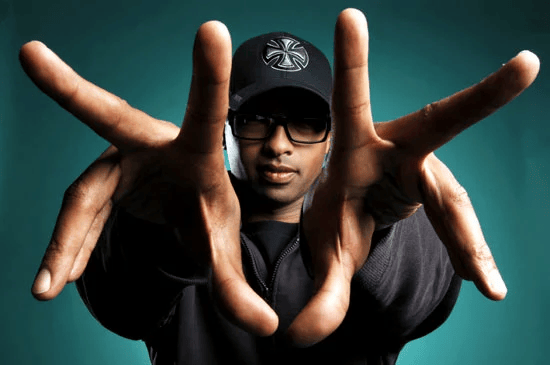


Kenna

Kenna Zemedkun was born in Addis Ababa, Ethiopia, and raised in Virginia Beach, where he became close friends with Chad Hugo of The Neptunes. That friendship produced his 2003 debut New Sacred Cow, produced largely by Hugo, and one of the more interesting records of its decade.

The problem was that nobody could file it. Kenna makes new wave — synthesisers, Depeche Mode and U2 as reference points, big melodic hooks — sung by a Black artist and produced by a hip-hop producer, at a moment when the American industry had no category for that. The album was reportedly shelved and delayed repeatedly.

He has since released sporadically, worked as a photographer and climate activist, and become a genuine cult figure — the kind of artist other musicians name.

What to listen for

"Hell Bent"-era material and "Daylight" are the closest to conventional pop and the best entry points.

"Baptized In Blacklight" is the signature track from Make Sure They See My Face and shows the full scope of the production — enormous, layered, and genuinely strange.

"Say Goodbye To Love" is the most emotionally direct, and "Be Still" the quietest.

"Games You Can Win" with RJD2 is the collaboration worth flagging — RJD2 is one of the great instrumental hip-hop producers, and the pairing suits both.

"vexed and glorious," "war in me" and "love/hate sensation" come from his later, more experimental work.

"Static" and "Loose Wires / Blink Radio" are the deepest cuts here.

Throughout, listen to the vocal placement. Kenna sings high and slightly detached, which is a new wave inheritance rather than an R&B one, and it is the single thing that most confused the people trying to market him.

Go deeper

New Sacred Cow (2003) is the album, and it is worth seeking out.

Chad Hugo's work outside The Neptunes is the thread to pull — he is consistently the less-discussed half of that partnership and arguably the more musically curious.

For artists caught in the same categorisation trap: TV on the Radio, Bloc Party's Kele Okereke, Santigold and, going back, Fishbone and Living Colour. The history of Black artists in rock is long and has been repeatedly erased.

A closing thought on what went wrong. Kenna's career is the clearest case study available in how badly the American industry handled artists who did not fit a demographic assumption — the music was finished, the producer was one of the most successful alive, and the problem was entirely one of categorisation. Two decades on, the genre-fluidity that made him unmarketable is simply how pop works.

Comments

Popular posts from this blog

Monty Alexander VibeZ

There is a moment on almost every Monty Alexander record where the jazz piano trio stops behaving like a jazz piano trio and starts behaving like a Kingston sound system. That moment is the whole point. Fifty tracks deep, this is the sound of a man who never asked permission to be two things at once. The pianist who brought Kingston to the Carnegie stage Monty Alexander was born in Kingston, Jamaica in 1944, and by his teens he was already gigging around the island — close enough to the birth of ska and rocksteady to have absorbed it in his bones rather than learned it from records. He moved to the United States in 1961, and the origin story that follows is the kind that sounds invented: Frank Sinatra heard him playing in a Miami club, and Jilly Rizzo, Sinatra's friend and club owner, put him behind the piano at Jilly's in New York. From there Alexander fell in with Milt Jackson and Ray Brown, two of the most demanding rhythm partners in the music, and never really ...

GuiltyBeatZ VibeZ

If you have danced to anything out of Accra in the last ten years, you have probably danced to GuiltyBeatz without knowing his name. Forty-seven tracks of a producer's fingerprints — and the fingerprints turn out to be the melody. The Ghanaian producer who made Afrobeats swing Ronald Banful, who records as GuiltyBeatz, is a Ghanaian producer and DJ whose sound sits at the crossroads where Ghanaian highlife, Nigerian Afrobeats, amapiano and UK dance music all meet. He came up producing for Mr Eazi — the Banku Music partnership is where a lot of listeners first heard him — and his breakout as a name in his own right came with "Akwaaba," the 2018 track with Mr Eazi, Patapaa and Pappy Kojo that spawned a dance craze and became one of the defining African club records of its year. His reputation went global when he worked on Beyoncé's The Lion King: The Gift , but the more interesting story is the consistency. A GuiltyBeatz beat is usually ide...

Kashif VibeZ

Kashif is the reason a lot of 1980s R&B sounds the way it does — and the reason you can hear the difference between a synth bassline played by someone who understood bass and one programmed by someone who didn't. This is a producer's playlist, and the producer is everywhere. The architect of the synthesized soul record Kashif was born Michael Jones in Brooklyn in 1956, raised in foster care, and taught himself music young enough that by his teens he was touring with B.T. Express. What he did next reshaped a decade. In the early 1980s, as a producer, arranger and multi-instrumentalist, he was among the first to build R&B records around programmed synthesizers — the Minimoog bass, the Linn drum machine, the Fairlight — without letting them sound cold. That distinction matters. Plenty of producers adopted the new gear; Kashif made it groove . His basslines are played with the phrasing of a funk bassist, full of slides and ghost notes, which is why rec...