
After 7 VibeZ

Sixteen tracks from a Cincinnati vocal trio who made some of the most beautifully arranged R&B of the early 1990s and are barely remembered.
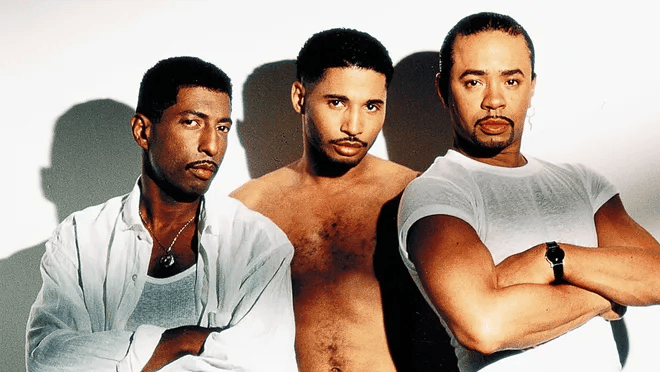

After 7

After 7 were Kevon Edmonds, Melvin Edmonds and Keith Mitchell — and the family tree is the story. Kevon and Melvin are the older brothers of Babyface; Keith Mitchell is a cousin of L.A. Reid. The group was therefore signed to Virgin with the two most successful writer-producers in R&B working on their behalf.

What they brought was harmony. Where most of their contemporaries were built around a single lead, After 7 were a genuine three-part group in the older tradition, and the arrangements — largely by Babyface and L.A. Reid — are unusually sophisticated.

Melvin Edmonds died in 2019. The group has continued in various forms.

What to listen for

"Ready Or Not" and "Can't Stop" are the two that made them — both from the 1989 debut, and both perfectly constructed.

"'Til You Do Me Right" is their biggest and best: a Babyface and L.A. Reid production with a horn arrangement and a vocal blend that almost nobody was attempting by 1995.

"Heat Of The Moment" and "Nights Like This" — the latter from the Five Heartbeats soundtrack — are the deep cuts their audience holds closest.

The covers are excellent. "Sara Smile" is the Hall & Oates song, and taking it on as a vocal group makes explicit what that record always was. "Baby I'm For Real (Natural High)" combines the Originals and Bloodstone into one medley.

"One Night" and "How Do You Tell the One" are the ballads, and "Sprung On It" and "Gonna Love You Right" the up-tempo ones.

"Not Enough Hours In The Night" is the one to play last.

Go deeper

After 7 (1989) and Reflections (1995) are the two albums.

Kevon Edmonds' solo record 24/7 is worth finding — its title track was a genuine hit and he is a superb singer.

For the Cincinnati connection: the Deele, where Babyface and L.A. Reid met, and the whole Midwestern soul scene that produced them.

And for the male vocal group tradition generally: The Whispers, The Manhattans, Boyz II Men and Jodeci — four very different answers to the same question about what three or four voices can do together.

One last point about the family advantage. Having Babyface and L.A. Reid writing for you is an enormous head start, and it is also a trap — After 7 were never entirely allowed to be their own group rather than a vehicle for other people's songs. The blend was genuinely theirs, though, and on the tracks where it is foregrounded you can hear a group who deserved a longer run.

Comments

Popular posts from this blog

Monty Alexander VibeZ

There is a moment on almost every Monty Alexander record where the jazz piano trio stops behaving like a jazz piano trio and starts behaving like a Kingston sound system. That moment is the whole point. Fifty tracks deep, this is the sound of a man who never asked permission to be two things at once. The pianist who brought Kingston to the Carnegie stage Monty Alexander was born in Kingston, Jamaica in 1944, and by his teens he was already gigging around the island — close enough to the birth of ska and rocksteady to have absorbed it in his bones rather than learned it from records. He moved to the United States in 1961, and the origin story that follows is the kind that sounds invented: Frank Sinatra heard him playing in a Miami club, and Jilly Rizzo, Sinatra's friend and club owner, put him behind the piano at Jilly's in New York. From there Alexander fell in with Milt Jackson and Ray Brown, two of the most demanding rhythm partners in the music, and never really ...

GuiltyBeatZ VibeZ

If you have danced to anything out of Accra in the last ten years, you have probably danced to GuiltyBeatz without knowing his name. Forty-seven tracks of a producer's fingerprints — and the fingerprints turn out to be the melody. The Ghanaian producer who made Afrobeats swing Ronald Banful, who records as GuiltyBeatz, is a Ghanaian producer and DJ whose sound sits at the crossroads where Ghanaian highlife, Nigerian Afrobeats, amapiano and UK dance music all meet. He came up producing for Mr Eazi — the Banku Music partnership is where a lot of listeners first heard him — and his breakout as a name in his own right came with "Akwaaba," the 2018 track with Mr Eazi, Patapaa and Pappy Kojo that spawned a dance craze and became one of the defining African club records of its year. His reputation went global when he worked on Beyoncé's The Lion King: The Gift , but the more interesting story is the consistency. A GuiltyBeatz beat is usually ide...

Kashif VibeZ

Kashif is the reason a lot of 1980s R&B sounds the way it does — and the reason you can hear the difference between a synth bassline played by someone who understood bass and one programmed by someone who didn't. This is a producer's playlist, and the producer is everywhere. The architect of the synthesized soul record Kashif was born Michael Jones in Brooklyn in 1956, raised in foster care, and taught himself music young enough that by his teens he was touring with B.T. Express. What he did next reshaped a decade. In the early 1980s, as a producer, arranger and multi-instrumentalist, he was among the first to build R&B records around programmed synthesizers — the Minimoog bass, the Linn drum machine, the Fairlight — without letting them sound cold. That distinction matters. Plenty of producers adopted the new gear; Kashif made it groove . His basslines are played with the phrasing of a funk bassist, full of slides and ghost notes, which is why rec...