
The Producer Series: Organized Noize

Twenty-five tracks from three men in an Atlanta basement who invented Southern hip-hop and then quietly wrote one of the biggest pop records of the 1990s.
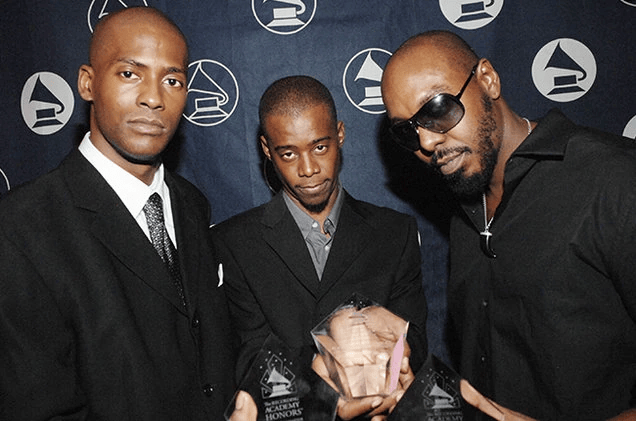

Organized Noize

Rico Wade, Ray Murray and Sleepy Brown worked out of a basement studio in Wade's mother's house in East Point, Atlanta — The Dungeon. What came out of it reshaped American music.

Their method was the opposite of the prevailing one. Where New York producers built from samples, Organized Noize used live musicians — real bass, live guitar, horns, Sleepy Brown singing hooks — and applied a Southern rhythmic sensibility rooted in funk and gospel. That decision is why OutKast and Goodie Mob sounded like nothing else when they arrived.

The Dungeon Family that grew around them — OutKast, Goodie Mob, Society of Soul, Big Rube, and later Janelle Monáe and Killer Mike — is one of the most productive collectives in the history of the genre.

Rico Wade died in April 2024.

What to listen for

TLC's "Waterfalls" is the crossover monument — a number one pop single about AIDS and drug violence, with a horn arrangement and live bass, produced by the same men who made Southernplayalisticadillacmuzik. It is one of the strangest commercial successes of the decade.

OutKast's "Player's Ball" and "Southernplayalisticadillacmuzik" are the origin, and "Elevators (Me & You)" is the record where André and Big Boi stop being a regional act.

"SpottieOttieDopaliscious" and "Liberation" are the two that show what the live-band approach could do at length — neither is really a rap song, and both are among the best things the genre has produced.

Goodie Mob's "Cell Therapy" and "Soul Food" are the harder, more paranoid side of the same operation.

En Vogue's "Don't Let Go (Love)" is the other major pop credit, and Janelle Monáe's "I Like That" shows the lineage continuing twenty years on.

Mista's "Blackberry Molasses" is the deep cut — and a young Bobby Valentino is singing on it.

Go deeper

OutKast's ATLiens and Aquemini are the essential albums, and Goodie Mob's Soul Food is the other pillar.

The documentary The Art of Organized Noize tells the story properly and is well worth watching.

Sleepy Brown's own records are underrated — he is a genuinely good soul singer as well as a producer.

Listening note: listen for the live instruments buried in the tracks. Organized Noize built beats out of played parts rather than loops alone, and that decision is why their productions still swing where contemporaries from the same years sound locked to a grid.

Comments

Popular posts from this blog

Monty Alexander VibeZ

There is a moment on almost every Monty Alexander record where the jazz piano trio stops behaving like a jazz piano trio and starts behaving like a Kingston sound system. That moment is the whole point. Fifty tracks deep, this is the sound of a man who never asked permission to be two things at once. The pianist who brought Kingston to the Carnegie stage Monty Alexander was born in Kingston, Jamaica in 1944, and by his teens he was already gigging around the island — close enough to the birth of ska and rocksteady to have absorbed it in his bones rather than learned it from records. He moved to the United States in 1961, and the origin story that follows is the kind that sounds invented: Frank Sinatra heard him playing in a Miami club, and Jilly Rizzo, Sinatra's friend and club owner, put him behind the piano at Jilly's in New York. From there Alexander fell in with Milt Jackson and Ray Brown, two of the most demanding rhythm partners in the music, and never really ...

GuiltyBeatZ VibeZ

If you have danced to anything out of Accra in the last ten years, you have probably danced to GuiltyBeatz without knowing his name. Forty-seven tracks of a producer's fingerprints — and the fingerprints turn out to be the melody. The Ghanaian producer who made Afrobeats swing Ronald Banful, who records as GuiltyBeatz, is a Ghanaian producer and DJ whose sound sits at the crossroads where Ghanaian highlife, Nigerian Afrobeats, amapiano and UK dance music all meet. He came up producing for Mr Eazi — the Banku Music partnership is where a lot of listeners first heard him — and his breakout as a name in his own right came with "Akwaaba," the 2018 track with Mr Eazi, Patapaa and Pappy Kojo that spawned a dance craze and became one of the defining African club records of its year. His reputation went global when he worked on Beyoncé's The Lion King: The Gift , but the more interesting story is the consistency. A GuiltyBeatz beat is usually ide...

Kashif VibeZ

Kashif is the reason a lot of 1980s R&B sounds the way it does — and the reason you can hear the difference between a synth bassline played by someone who understood bass and one programmed by someone who didn't. This is a producer's playlist, and the producer is everywhere. The architect of the synthesized soul record Kashif was born Michael Jones in Brooklyn in 1956, raised in foster care, and taught himself music young enough that by his teens he was touring with B.T. Express. What he did next reshaped a decade. In the early 1980s, as a producer, arranger and multi-instrumentalist, he was among the first to build R&B records around programmed synthesizers — the Minimoog bass, the Linn drum machine, the Fairlight — without letting them sound cold. That distinction matters. Plenty of producers adopted the new gear; Kashif made it groove . His basslines are played with the phrasing of a funk bassist, full of slides and ghost notes, which is why rec...