
Elton John: My Top 20 Faves

Twenty tracks from one of the most successful songwriting partnerships in history. Elton John wrote the music; Bernie Taupin wrote the words; they mostly did it apart.
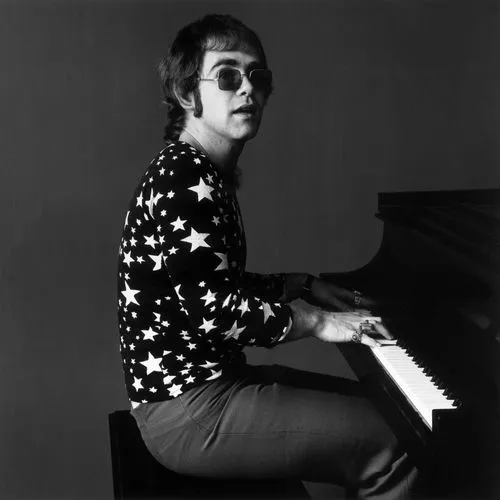

Elton John and Bernie Taupin

The partnership is the story. Elton John and Bernie Taupin answered the same 1967 advertisement in a music paper and have written together for nearly sixty years using a method that should not work: Taupin writes complete lyrics and hands them over; John sets them to music, often in under an hour, frequently without asking what they mean.

What that produced, particularly between 1970 and 1976, is one of the great runs in popular music — seven consecutive number one albums in America, and a body of songs that has proved almost indestructible.

John is also a considerable pianist with a gospel and boogie-woogie foundation, and his commitment to AIDS research and to championing other artists — he has been an unusually generous public advocate for younger musicians — is a substantial second legacy.

What to listen for

"Your Song" is the one that started it, and Taupin was seventeen when he wrote the lyric — which explains its slight awkwardness and is exactly why it works.

"Rocket Man" and "Bennie And The Jets" are the two that show the range of the partnership: one a study in loneliness, the other a piece of glam-rock theatre with a fake live audience dubbed on.

"Someone Saved My Life Tonight" is the most autobiographical thing they made — about John's near-marriage and a friend's intervention — and is the best song here.

"Don't Let The Sun Go Down On Me" live with George Michael at Wembley is the version most people know, and it went to number one.

"Candle In The Wind" is complicated: written about Marilyn Monroe, rewritten for Princess Diana's funeral, and in that form one of the best-selling singles ever released.

"That's What Friends Are For" with Dionne Warwick, Gladys Knight and Stevie Wonder raised millions for AIDS research at a moment when very few public figures would touch the subject.

"Lucy In The Sky With Diamonds" is the Beatles cover, with John Lennon playing guitar on it.

Go deeper

Goodbye Yellow Brick Road (1973) is the album, and Tumbleweed Connection (1970) — a set of songs about the American West written by two Englishmen who had never been there — is the cult favourite.

Bernie Taupin's contribution is routinely underweighted; reading the lyrics separately is instructive.

And the piano playing is worth attending to — the debt to Leon Russell and to gospel is obvious once you listen for it.

Comments

Popular posts from this blog

Monty Alexander VibeZ

There is a moment on almost every Monty Alexander record where the jazz piano trio stops behaving like a jazz piano trio and starts behaving like a Kingston sound system. That moment is the whole point. Fifty tracks deep, this is the sound of a man who never asked permission to be two things at once. The pianist who brought Kingston to the Carnegie stage Monty Alexander was born in Kingston, Jamaica in 1944, and by his teens he was already gigging around the island — close enough to the birth of ska and rocksteady to have absorbed it in his bones rather than learned it from records. He moved to the United States in 1961, and the origin story that follows is the kind that sounds invented: Frank Sinatra heard him playing in a Miami club, and Jilly Rizzo, Sinatra's friend and club owner, put him behind the piano at Jilly's in New York. From there Alexander fell in with Milt Jackson and Ray Brown, two of the most demanding rhythm partners in the music, and never really ...

GuiltyBeatZ VibeZ

If you have danced to anything out of Accra in the last ten years, you have probably danced to GuiltyBeatz without knowing his name. Forty-seven tracks of a producer's fingerprints — and the fingerprints turn out to be the melody. The Ghanaian producer who made Afrobeats swing Ronald Banful, who records as GuiltyBeatz, is a Ghanaian producer and DJ whose sound sits at the crossroads where Ghanaian highlife, Nigerian Afrobeats, amapiano and UK dance music all meet. He came up producing for Mr Eazi — the Banku Music partnership is where a lot of listeners first heard him — and his breakout as a name in his own right came with "Akwaaba," the 2018 track with Mr Eazi, Patapaa and Pappy Kojo that spawned a dance craze and became one of the defining African club records of its year. His reputation went global when he worked on Beyoncé's The Lion King: The Gift , but the more interesting story is the consistency. A GuiltyBeatz beat is usually ide...

Kashif VibeZ

Kashif is the reason a lot of 1980s R&B sounds the way it does — and the reason you can hear the difference between a synth bassline played by someone who understood bass and one programmed by someone who didn't. This is a producer's playlist, and the producer is everywhere. The architect of the synthesized soul record Kashif was born Michael Jones in Brooklyn in 1956, raised in foster care, and taught himself music young enough that by his teens he was touring with B.T. Express. What he did next reshaped a decade. In the early 1980s, as a producer, arranger and multi-instrumentalist, he was among the first to build R&B records around programmed synthesizers — the Minimoog bass, the Linn drum machine, the Fairlight — without letting them sound cold. That distinction matters. Plenty of producers adopted the new gear; Kashif made it groove . His basslines are played with the phrasing of a funk bassist, full of slides and ghost notes, which is why rec...