
Forty-two tracks spanning six decades of a career that has no real equivalent. Quincy Jones died on 3 November 2024, aged ninety-one.
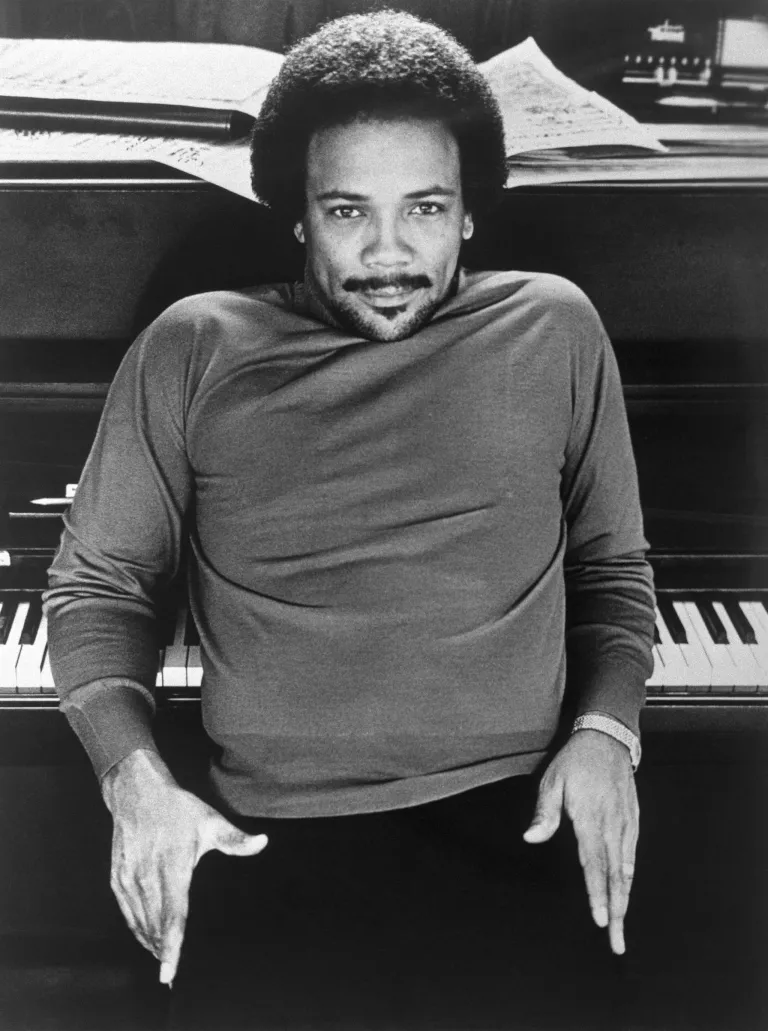
Quincy Jones (1933–2024)
Quincy Jones was a trumpeter, then an arranger, then a film composer, then a record executive, then the producer of the best-selling album ever made — and he was genuinely first-rate at each of those jobs in turn, which is the part that beggars belief.
He arranged for Count Basie and Frank Sinatra. He wrote film scores when Black composers were almost entirely excluded from that work. He ran a label, produced television, and then in his late forties took on a former child star's solo career and reorganised popular music around it.
His method was consistent across all of it: hire the best musicians available, give them room, and edit ruthlessly. He treated a pop single with the same structural seriousness as an orchestral chart.
What to listen for
The Michael Jackson material is the centre and needs no defence — but listen to it for arrangement rather than hooks. "Rock With You" and "Human Nature" are masterclasses in what to leave out; "Billie Jean" is famous partly for how little is in it.
The Brothers Johnson's "Strawberry Letter 23" and "I'll Be Good To You" are the funk productions, and the former has one of the most beautiful guitar tones ever committed to tape.
"Ai No Corrida" and "Betcha Wouldn't Hurt Me" come from his own albums, where he behaves like a bandleader rather than a producer.
"Just Once" and "One Hundred Ways" gave James Ingram his career, and "Baby, Come To Me" with Patti Austin is the other half of that story.
"Moody's Mood For Love" with Take 6, Brian McKnight and Rachelle Ferrell is the jazz-vocal showpiece, and "Soul Bossa Nova" is the 1962 instrumental that outlived every context it was ever placed in.
Aretha Franklin's "Angel" and "Somewhere" are the ones to sit with quietly.
Go deeper
The Dude (1981) and Back on the Block (1989) are the essential solo albums. Walking in Space (1969) is where the jazz arranger and the pop producer meet.
His autobiography, Q, is worth reading for the studio detail alone, and his early work for Count Basie explains everything about how he later built a pop record.
Listening note: the through-line across sixty years is editing. Jones' instinct was always to remove rather than to add, which is why a 1962 big-band chart and a 1982 pop single share the same quality of air around the parts. Listen for what is missing and the whole catalogue starts to sound like one person's work.
Comments
Post a Comment