Twenty-seven tracks from an album about fire — twenty-seven short pieces that behave more like a suite than a collection of songs.
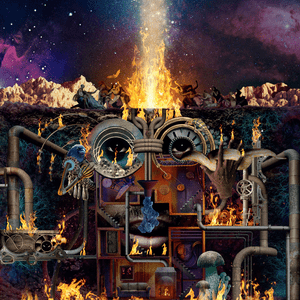
Flying Lotus: Flamagra (2019)
Steven Ellison works in a tradition he was partly born into: his great-aunt was Alice Coltrane, and the spiritual-jazz restlessness of that lineage runs through everything he makes. As Flying Lotus he became the central figure of the Los Angeles beat scene, and the founder of a sensibility that treats hip-hop production as composition rather than as backing.
Flamagra is his most ambitious record. Built around the loose image of an eternal flame, it runs twenty-seven tracks in just over an hour, which means most pieces last two minutes or less and function as movements rather than songs. The guest list is enormous and none of the guests is allowed to take over.
What to listen for
"Fire Is Coming" with David Lynch is the most talked-about thing here, and rightly: Lynch narrates a short, deeply unsettling story, and the track is closer to radio drama than to music.
"Land Of Honey" with Solange is the most beautiful piece on the album and the one that most rewards being played on its own.
"Burning Down The House" with George Clinton is the funk lineage acknowledged directly, and "More" with Anderson .Paak is the closest thing to a single.
"Yellow Belly" with Tierra Whack and "Black Balloons Reprise" with Denzel Curry are the rap features, and both are used as texture as much as performance.
"The Climb" with Thundercat is the musicians' pick — the bass playing alone justifies it.
"Thank U Malcolm" is the tribute to Mac Miller, who had died the previous year, and it is placed near the end with no announcement at all.
"Post Requisite" and "Takashi" are where the drum programming is most extraordinary.
Go deeper
Cosmogramma (2010) is the masterpiece and the album that established the aesthetic; You're Dead! (2014) is the jazz record.
Alice Coltrane's Journey in Satchidananda is the ancestral text. Thundercat, Kamasi Washington and the Brainfeeder label roster are the surrounding scene, and J Dilla's Donuts is the other essential reference.
How to hear it: the twenty-seven tracks are movements rather than songs, and shuffling the album destroys it completely. Most pieces last under two minutes and end mid-thought because the next one answers them. Play it whole, in order, and the thing turns out to have a shape; play it on random and it is a folder of fragments.
Comments
Post a Comment